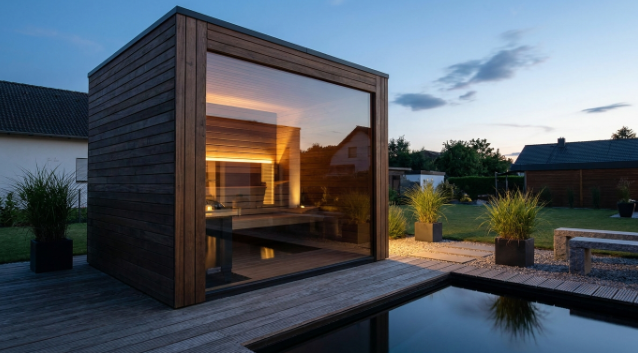

hoosing between cedar and heat-treated hemlock for a cube sauna comes down to four practical factors: budget, weight, scent, and how much finish maintenance you want to do. Heat-treated hemlock costs less, weighs less, and is dimensionally more stable straight out of the kiln; cedar costs more, carries a stronger natural aroma, and needs essentially no chemical treatment to resist rot on its own. Neither wood is wrong for a cube sauna. The right one depends on which tradeoffs matter to your budget and your backyard.
Step 1: Decide How Much the Cost Difference Matters
Heat-treated hemlock is generally the more budget-friendly option of the two, which is why it shows up as the standard wall material on a large share of entry-level and mid-range cube sauna kits. Clear, knot-free cedar commands a premium because the tree grows slower and the clear-grade lumber yield per log is lower. If the sauna budget is tight and the cost difference between wood species would mean cutting a corner elsewhere, like a smaller heater or a lower-grade bench, heat-treated hemlock is usually the more sensible default. If cedar’s price premium fits comfortably in the budget, it buys a genuine upgrade in scent and long-term rot resistance without any chemical treatment.
Step 2: Weigh the Weight and Stability Difference
The heat-treatment process used on hemlock drives out much of the wood’s internal moisture and breaks down the sugars that would otherwise feed fungal decay, and the result is a noticeably lighter board than air-dried cedar of the same dimension. That matters two ways for a cube sauna: a lighter shell is easier to move into a tight backyard or over uneven ground during install, and the kiln process leaves the wood more dimensionally stable, meaning less shrinking, swelling, or seam gapping as humidity swings through the seasons. Cedar is a stable species in its own right and has been the traditional sauna wood choice for decades, but it typically retains slightly more natural moisture than kiln-treated hemlock and can move a bit more with big humidity or temperature swings, particularly in a cube design where flat panel seams show gaps more visibly than a barrel’s curved staves.
Step 3: Decide If the Cedar Scent Is a Priority
Cedar’s resinous, unmistakable aroma is part of why it became the standard for saunas in the first place, and for a lot of buyers that scent is the whole point of choosing real cedar over an alternative. Heat-treated hemlock has a milder, slightly toasted or nutty smell from the kiln process, present but noticeably softer than cedar’s. Neither scent is artificial or added; both come from the wood itself reacting to heat. If walking into the cabin and immediately smelling classic sauna wood matters to you, that alone can be reason enough to pay cedar’s premium.
Step 4: Match the Wood to Your Climate
Cedar’s natural oils and tannins give it built-in resistance to rot, insects, and decay without any applied finish, which makes it a strong choice in humid or rainy climates where a cube sauna’s exterior takes repeated wetting. Heat-treated hemlock’s stability from the kiln process makes it well suited to climates with big seasonal swings between hot, dry summers and cold, damp winters, since it resists the warping that stresses wall panel seams. In consistently dry climates, either species performs well and the decision comes down more to budget and scent than to durability concerns.
Step 4.5: Consider a Mixed Build
Some cube sauna manufacturers offer a mixed build, using heat-treated hemlock for the exterior wall panels and a small amount of cedar for the benches and interior trim, where skin contact and scent matter most. This splits the cost difference: the bulk of the structure uses the more affordable, stable hemlock, while the parts you actually sit on and smell closest to get cedar’s benefits. It is not offered on every model, but it is worth asking about if the full-cedar price feels like a stretch but the hemlock-only build feels like it is missing something.
Step 5: Compare Real Listings Before Buying
Once you know which wood fits your budget and climate, compare how different manufacturers spec it, since “cedar” on a spec sheet can mean anything from clear, knot-free boards to a lower economy grade with visible knots, and that grade difference affects both appearance and price more than the species choice itself. Look for a listing that states the wood grade explicitly, not just the species name. A number of cube sauna retailers, including https://sweatdecks.com, list wood species and grade on individual product pages, which is worth checking side by side with at least one other retailer before you commit, since prices and grading can vary meaningfully between sellers for what looks like the same spec on paper.
What the Research Says About Sauna Use in General
Whichever wood you choose, the wall material itself is not what drives the documented health associations connected to regular sauna bathing; those findings relate to heat exposure and session frequency, not to the species of wood in the cabin. Reviews summarizing the evidence describe consistent associations between regular sauna use and favorable cardiovascular and general health outcomes across multiple cohort studies, phrased carefully as association rather than proof of direct causation. The wood choice affects comfort, scent, maintenance, and how the cabin ages, not the physiological response to heat itself.
Frequently Asked Questions
Is cedar or heat-treated hemlock better for a cube sauna?
Neither is objectively better; cedar carries a natural scent and rot resistance at a higher price, while heat-treated hemlock is lighter, more budget-friendly, and dimensionally stable but needs slightly more attention to the finish over time. The right pick depends on budget, climate, and whether you want the cedar aroma.
Why is heat-treated hemlock lighter than cedar?
The heat-treatment process drives out much of the wood’s internal moisture and breaks down sugars that would otherwise feed decay, which reduces density and weight compared to naturally air-dried cedar of the same dimension.
Does heat-treated hemlock smell like a sauna?
Heat-treated hemlock has a mild, slightly toasted or nutty scent from the kiln process, noticeably softer than cedar’s strong, resinous aroma. If the classic sauna smell matters to you, cedar is the more distinctive choice.
Which wood costs less for a cube sauna?
Heat-treated hemlock is typically the more affordable of the two, often running noticeably less per square foot than clear cedar, which is one reason many entry-level and mid-range cube sauna kits use it as the standard wall material.
References
- Benefits and risks of sauna bathing, The American Journal of Medicine, 2001
- Effects of heat and cold on health, with special reference to Finnish sauna bathing, American Journal of Physiology, 2018
- Clinical Effects of Regular Dry Sauna Bathing: A Systematic Review, Evidence-Based Complementary and Alternative Medicine, 2018
By Tom Bracken