

In the high-stakes world of United States higher education admissions, brevity is often the ultimate test of a student’s communication skills. While the 650-word Common App personal statement provides room for narrative flair, the “supplemental prompts”—often capped at a restrictive 150 words—are where many applications succeed or fail in the 2026 cycle.
Whether you are applying to the University of Michigan, which famously uses a 150-word “Community” prompt, or navigating the short-answer sections of the Ivy League, the goal is the same: maximum impact with minimum word count. In this guide, we explore why these “micro-essays” matter and how to master them without losing your unique voice.
Why the 150-Word Limit is a Strategic Filter
Admissions officers at elite US institutions review tens of thousands of applications annually. According to the National Association for College Admission Counseling (NACAC), “writing” remains a top-tier factor in holistic review processes. The 150-word limit isn’t just about saving time; it’s a test of your ability to prioritize information, edit ruthlessly, and demonstrate “intellectual vitality”—a term frequently used by Stanford and Harvard admissions teams.
Navigating these technical constraints can be daunting for students used to longer formats. This is why many domestic and international applicants seek a professional custom assignment service in the USA to ensure their supplemental responses are polished, punchy, and strategically aligned with a university’s specific values. Having an expert eye can help identify which parts of your story are essential and which are merely “fluff” that can be discarded to meet the character count.
Tips for Writing 150-Word Supplemental Essays
Writing short is significantly harder than writing long. As Mark Twain famously (and ironically) noted, “I didn’t have time to write a short letter, so I wrote a long one instead.” In the context of a 150-word essay, every single word must earn its place on the page.
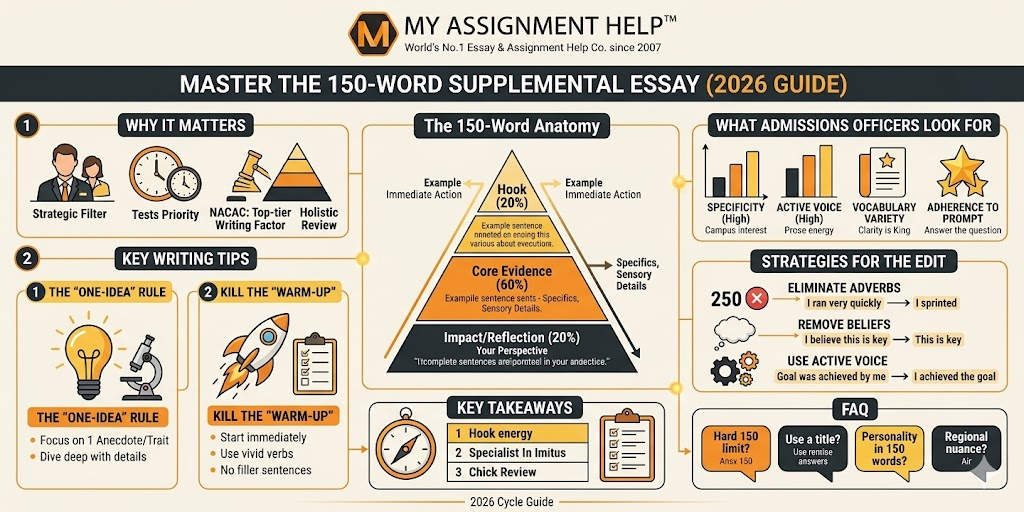
[INFOGRAPHIC: The 150-Word Anatomy]
- The Hook (20%): A vivid, immediate opening that drops the reader into the action.
- The Core Evidence (60%): The “meat” of the response—specific details and sensory language.
- The Impact/Reflection (20%): The “so what?”—how this experience shaped your perspective.
1. The “One-Idea” Rule
You cannot tell your entire life story in 150 words. You must choose one specific anecdote or personality trait. If the prompt asks about a meaningful activity, don’t list five; dive deep into the specific sensory details of one moment.
2. Kill the “Warm-up” Sentence
In a standard essay, you might start with: “Throughout my four years of high school, I have participated in many clubs, but the one that shaped me most was the Debate Team.”
In a 150-word response, that is 26 wasted words. Better: “Standing at the podium in the state finals, my hands shook, but my voice remained steady.” (15 words).
Data-Driven Insights: What 2026 Admissions Officers Look For
Data from the Common Application indicates that the average student applies to approximately 9 to 12 schools. With each school requiring 1–3 supplements, students are often writing upwards of 25 “micro-essays.” Consistency across these short bursts of writing is key to a successful profile.
| Feature | Impact on Admissions Score | Why it Matters |
| Specificity | High | Shows genuine interest in the specific campus culture. |
| Active Voice | High | Saves word count and adds vital energy to the prose. |
| Vocabulary Variety | Medium | Avoid “thesaurus syndrome”—clarity beats “big” words. |
| Adherence to Prompt | Essential | Failure to answer the specific question results in immediate disqualification. |
Strategies for the Edit: From 250 Words to 150
Most first drafts will naturally land around 200–250 words. The “Art of Conciseness” lies in the revision phase, where you strip the sentence down to its skeletal structure.
- Eliminate Adverbs: Instead of saying “I ran very quickly,” say “I sprinted.”
- Remove “I think” or “I believe”: The admissions officer knows it’s your opinion because you are the author.
- Active vs. Passive Voice: “The goal was achieved by me” (6 words) vs. “I achieved the goal” (4 words). Over a 150-word limit, these small savings add up to an entire extra sentence of content.
See also: Costume Designers Who Influenced Fashion
Key Takeaways
- Focus on the “Why”: Don’t just describe what you did; explain how it changed your perspective or prepared you for university.
- Every Word is Real Estate: Treat your word count like a budget. Spend it wisely on vivid verbs rather than empty adjectives.
- Regional Nuance: Ensure your tone matches the “vibe” of the US school—Midwestern schools often value community, while coastal tech hubs value disruption.
- Proofread for Precision: In a short text, a single typo stands out significantly more than in a 2,000-word term paper.
FAQ Section
Q: Can I go over the word count by just 5 words?
A: No. Most online application portals (like the Common App) use hard-coded text boxes that will literally cut off your sentence at the 150th word.
Q: Should I use a title for a 150-word essay?
A: Generally, no. A title eats into your word count. Start immediately with your “hook” to maximize space.
Q: Is 150 words enough to show my personality?
A: Absolutely. Think of it like a “pitch.” Use one specific, quirky detail that only you could provide to make yourself memorable.
Author Bio
Dr. Sarah Jenkins is a Senior Content Strategist and Academic Consultant at MyAssignmentHelp. With over 12 years of experience in the US higher education sector, Sarah specializes in helping students navigate the complexities of university admissions and professional academic writing. She holds a PhD in English Literature and is a frequent contributor to educational forums discussing the evolution of digital pedagogy.
References
- National Association for College Admission Counseling (NACAC). (2025). State of College Admission Report.
- The Common Application. (2026). Annual Student Trends and Supplemental Prompt Data.
- Zinsser, W. (2006). On Writing Well: The Classic Guide to Writing Nonfiction.
